Further Information
What is RS Risk Management?
Integrated risk management instead of separate individual solutions
Why risk management within Odoo?
One platform instead of Excel lists and island solutions
RS Risk Management relies on already existing master and process data. Hazards can be assigned to the affected business areas and processes without creating additional data sets.
THIS CREATES
- a common information base
- clear responsibilities
- current processing statuses
- transparent follow-up actions
- seamless processes without media breaks
linking risks with assets
considering hazards where they arise
Risk entries can be assigned to the assets managed there. This makes it clear which corporate value is affected and what consequences may arise from it.
Whether it's a machine, production line, server, vehicle, or other operational asset: you'll know at a glance:
05
which projects or tasks are related to it
04
which activities have already been initiated
03
how the respective assessment turns out
02
what hazards are present
01
which assets
are affected
Since the application is based on the existing master data of the Odoo Asset Management, no additional maintenance of the same information is required.
Why companies should connect risks with assets
More transparency. Better prioritization.
BY ASSIGNING TO ASSETS, IT BECOMES APPARENT
01 which machines are particularly risky
02 which IT systems need to be particularly protected
03 which operating resources are repeatedly associated with increased hazards
04 which matters can impair critical corporate values
These relationships form a solid foundation for investment decisions, resource planning, and the sequence of necessary activities.
Example
If there is an increased risk of failure with a production machine, you do not only see the classification. At the same time, you recognize which asset is affected, which steps have already been initiated, and which projects or processes would depend on a possible failure.
This is how RS Risk Management works
From risk entry to completed activity
With RS Risk Management, risk-relevant issues can be processed in a few steps.
02
Assess relevance
Use a RAG classification, the expected value, or a risk matrix to categorize the need for action.
03
Assign assets and processes
Connect the entry with affected assets, projects, tasks, or departments.
04
Define activities
Define concrete steps, responsible persons, and binding deadlines.
05
Monitor implementation
Track processing statuses within Odoo and keep changes documented without gaps.
01
Capture risk
Document the identified issue with description, category, and responsibility.
Functions
Everything for professional risk management within Odoo
RS Risk Management supports the entire process – from the collection and classification to the implementation and control of appropriate activities. All information is maintained within a shared environment and is currently available.
The application offers, among other things:
Digital Risk Register
Integration with the Odoo Asset Management App
Flexible Assessment Methods
RAG Classification
Risk Matrix
Expected Value-Based Analysis
Action Control
Project and Task Reference
Role and Permission Concept
History and Change Tracking
Central Risk Register
All Corporate Risks in One Place
Keep all relevant matters in view. The digital register consolidates all information and presents it in a uniform structure.
This creates a complete documentation of the company-wide risk situation.
- Category
- Status
- Extent of Damage
- Planned Activities
- Affected Assets
DATA PER ENTRY
- Description
- Responsible Person or Organizational Unit
- Probability of Occurrence
- Priority
- Assigned Projects and Tasks
DATA PER ENTRY
- Description
- Responsible Person or Organizational Unit
- Probability of Occurrence
- Priority
- Assigned Projects and Tasks
- Category
- Status
- Extent of Damage
- Planned Activities
- Affected Assets
Flexible Risk Assessment
Suitable for Your Internal Guidelines
Companies use different methods to assess hazards and potential impacts. Therefore, RS Risk Management supports several approaches that can be used depending on the requirements.
Available are, among others, the RAG classification, the expected value, and the classic risk matrix.
RAG assessment
Quickly identify need for action
The RAG assessment based on the Red-Yellow-Green principle allows for an easily understandable classification:
Green – low need for action
Yellow – medium need for action
Red – high or critical need for action
In particular, executives gain a quick overview of topics that require special attention.
Expected value-based assessment
Systematically prioritize issues
In the expected value-based consideration, probability of occurrence and potential damage extent are combined. The result creates a uniform basis for prioritizations, resource decisions, and management evaluations.
Probability × Damage extent = Expected value
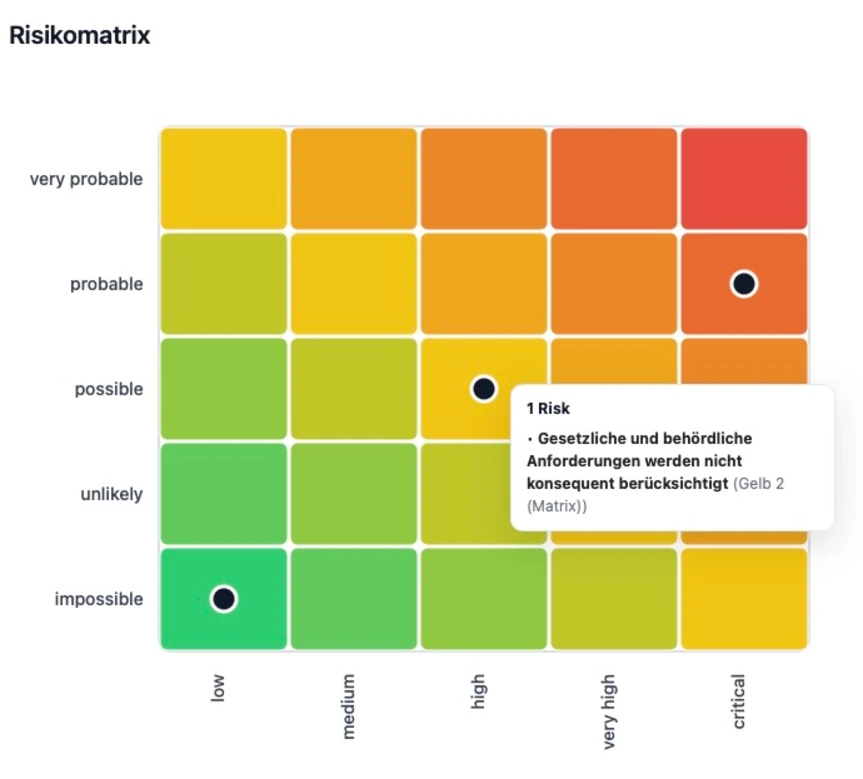
Risk Matrix
Graphically represent relationships
The risk matrix classifies relevant issues based on their probability of occurrence and potential impacts.
Critical combinations can be quickly identified. The graphical representation supports both operational coordination and management reviews.
Control, traceability, and configuration
Four areas where documentation becomes lived practice
A risk entry alone does not improve a process. What matters is that binding activities arise from it.
RS Risk Management enables the connection with projects and tasks within Odoo. Responsibilities, deadlines, and processing statuses are managed together and remain transparent.
Thus, an active control process develops from pure documentation.
Define who is responsible for a matter and which information can be viewed or processed.
Entries can be assigned to individual employees, teams, or departments. Individual access rights ensure that users only see the content relevant to their tasks.
Changes to entries, classifications, activities, or responsibilities are recorded within the application.
The history supports internal reviews, management decisions, and audits. Developments become visible and previous decisions remain clearly documented.
Every company works with its own categories, classifications, and processes. RS Risk Management can be adapted to these requirements.
CONFIGURABLE INCLUDE AMONG OTHERS
Risk categories | Status values | Probabilities of occurrence | Damage classes | Assessment models | Responsibilities
This application is oriented to your processes – not the other way around.
Use cases and application areas
A solution for different business areas
Risk-relevant topics arise in almost all areas – from production to IT to compliance and quality management. RS Risk Management helps to systematically represent, classify, and continuously monitor these.
Compliance & Governance 4 Use Cases
Capture regulatory issues, responsibilities, and follow-up actions within your Odoo environment. RS Risk Management supports transparent control and decision-making processes and facilitates the preparation of internal and external audits.
Compliance Management
Document compliance risks, classify them, and record associated responsibilities and processing steps.
Internal Control Systems (ICS)
Represent risks, controls, and resulting activities together in Odoo. Responsibilities can be clearly assigned, control processes can be transparently displayed, and potential weaknesses can be identified early.
Governance Processes
Create binding structures for dealing with company-relevant threats. Responsibilities, assessments, decisions, and follow-up steps can be clearly represented.
Internal and external audits
Provide relevant information, evaluations, responsibilities, and processing statuses in a structured manner for audits. The documented history facilitates internal reviews and supports preparation for external audits.
Asset Risk Management
Assign threats to your company's assets and gain a comprehensive overview of potential impacts, responsibilities, and planned steps.
Quality Management
Identify quality risks early and track improvement activities within your existing processes.
TYPICAL USE CASES
Quality deviations | Complaints | Corrective and preventive actions | Continuous improvement processes
Information Security & IT
Capture IT and cyber risks and assign them to the affected assets, such as servers, network components, or end devices.
TYPICAL SCENARIOS
Cyber attacks | System failures | Hardware defects | Security vulnerabilities | Failures of critical infrastructure
Production & Maintenance
Analyze threats related to machines, systems, and operating resources and assign them to the affected assets.
This allows for early identification of which systems require special attention and what steps should be initiated.
Project Management
Every project is associated with uncertainties. Capture project risks within your Odoo projects and keep track of deadlines, responsibilities, and necessary activities.
Enterprise Risk Management
Consolidate strategic and operational business risks on a common platform and create transparency across departments and business areas.
Occupational safety
Document hazards for employees, workplaces, and work equipment within Odoo and transparently support activities for risk reduction.
Why RS Risk Management?
Integrated instead of isolated
RS Risk Management connects the structured recording and classification of risks with the operational processes in Odoo. Responsibilities, activities, projects, tasks, and affected assets remain interconnected within a common platform.
This reduces media disruptions, avoids redundant maintenance, and creates a current information basis for operational and strategic decisions.
Why rising systems?
Your partner for Odoo and digital business processes
RS Risk Management was developed by rising systems AG to provide companies with a practical solution for integrated risk processes.
As an Odoo Silver Partner, we support organizations in digitizing their business processes and develop extensions that seamlessly integrate into the platform.
Our goal is to simplify complex processes, avoid system breaks, and make information available within a common working environment.
In addition to RS Risk Management, we develop other Odoo apps in the areas of finance, document management, quality management, maintenance, security, and process automation.
Frequently asked questions
RS Risk Management is an Odoo extension for the structured recording, classification, and management of corporate risks. The application connects relevant facts with projects, tasks, departments, and assets.
The solution is aimed at companies of various sizes and industries that want to document and address hazards in a structured manner – for example, in compliance, quality management, information security, production, or enterprise risk management.
- RAG assessment
- Expected value-based assessment
- Risk matrix
All types of risks, such as strategic, operational, IT, compliance, project, or occupational health and safety risks.
Yes. Risk entries can be assigned to the assets maintained in the Odoo asset management app. This makes it clear which assets are affected and which activities are planned or have already been implemented.
The assets created in Odoo asset management can be used, such as machines, production facilities, vehicles, servers, IT hardware, tools, and other operating resources.
Yes. Entries can be assigned to projects and tasks. This way, activities can be planned, responsibilities can be defined, and processing statuses can be checked.
Yes. RS Risk Management uses the role and permission concept of Odoo. Access can be specifically controlled and responsibilities can be clearly regulated.
RS Risk Management is available for Odoo 17, Odoo 18, and Odoo 19. Information on compatibility with other versions is available upon request.
Yes. Categories, status values, evaluation models, and other settings can be adapted to the requirements of your company. If needed, rising systems develops additional custom functions.
Yes, through transparent documentation, status histories, and action histories.